
 admin
adminChoosing a career is one of the most important decisions in a person’s life. Many students and working professionals choose a career because of marks, family expectations, peer pressure, salary packages, or popular career trends. However, a career that looks successful for someone else may not necessarily be the right choice for you.
The right career should ideally match your interests, personality, natural abilities, strengths, skills, and long-term goals. This is where professional career counselling, an Advanced Psychometric Test, and an Advanced DMIT Test can help you understand yourself before making an important career decision.
Phase 1: Understand Your Interests Before Choosing a Career
The first step in career planning is understanding what you genuinely enjoy doing.
Your interests can indicate the type of activities, subjects, work environments, or professional roles that naturally attract you. For example, someone who enjoys understanding people may explore psychology, counselling, human resources, teaching, or social sciences. A person who enjoys numbers and analytical problems may be more comfortable with finance, accounting, data analysis, or technical fields.
However, interest alone should not be the only factor in choosing a profession.
A student may love a particular subject but may not have the required aptitude or personality characteristics for a related career. Therefore, professional career assessment should consider multiple dimensions rather than focusing on one preference.
Phase 2: Understand Your Personality with an Advanced Psychometric Test
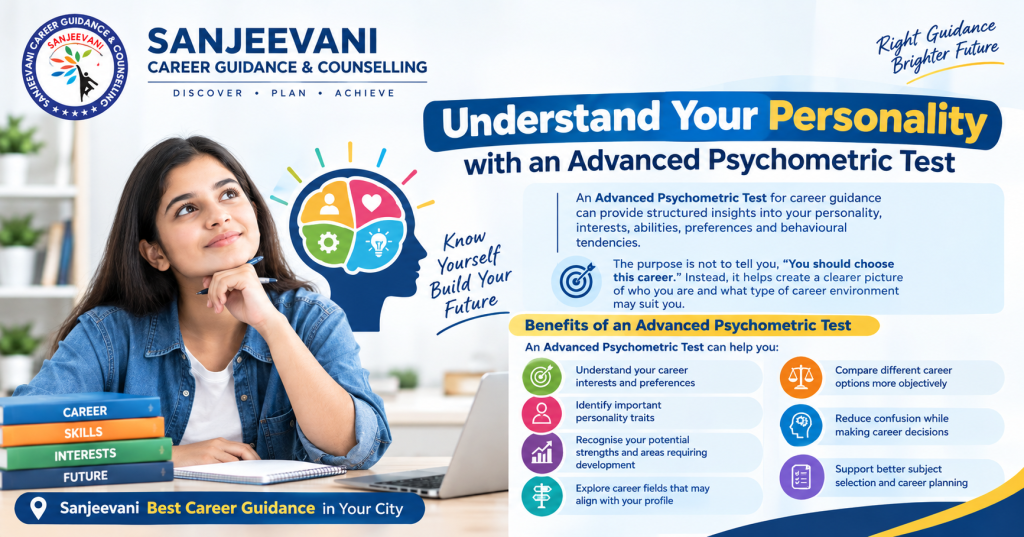
An Advanced Psychometric Test for career guidance can provide structured insights into your personality, interests, abilities, preferences, and behavioural tendencies.
The purpose of a psychometric assessment is not simply to tell you, “You should choose this career.” Instead, it can help create a clearer picture of who you are and what type of career environment may suit you.
Benefits of an Advanced Psychometric Test
An Advanced Psychometric Test can help you:
- Understand your career interests and preferences
- Identify important personality traits
- Recognise your potential strengths and areas requiring development
- Explore career fields that may align with your profile
- Compare different career options more objectively
- Reduce confusion while making career decisions
- Support better subject selection and career planning
- Understand whether your interests are compatible with your broader personal profile
This makes psychometric assessment particularly useful for students who are confused between multiple career options.
For example, instead of selecting a course simply because it is currently popular, a student can first understand their interests, personality, aptitude, and preferences and then explore suitable career possibilities.
Phase 3: Explore Natural Traits Through an Advanced DMIT Test
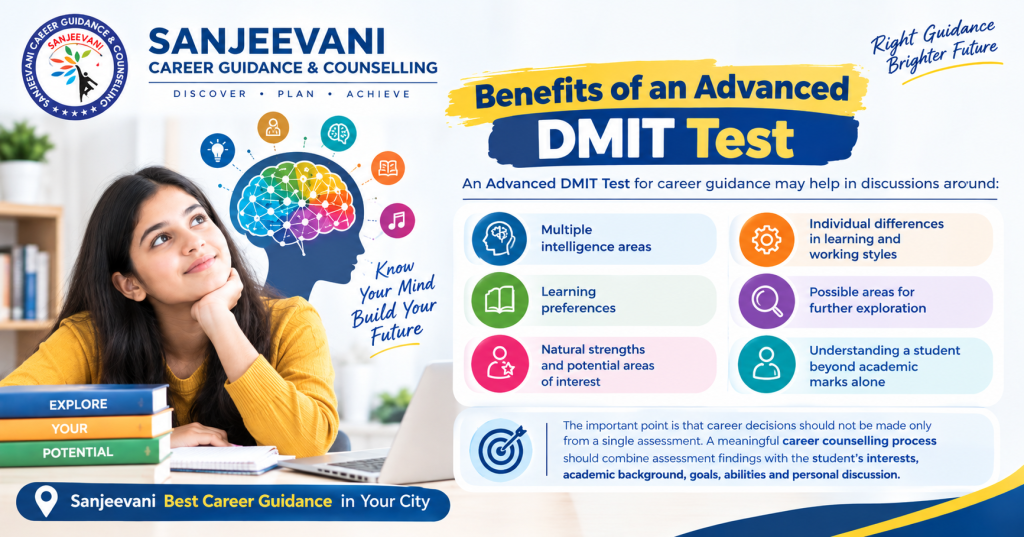
Another assessment used in career guidance is the Advanced DMIT Test.
DMIT, or Dermatoglyphics Multiple Intelligence Test, is presented as an assessment based on fingerprint patterns and is often used in some career-guidance settings to discuss areas such as learning preferences and multiple-intelligence profiles.
At Sanjeevani, the Advanced DMIT Test is used as part of a broader career-guidance process rather than treating one test as the complete answer to a person’s career.
Benefits of an Advanced DMIT Test
An Advanced DMIT Test for career guidance may help in discussions around:
- Multiple intelligence areas
- Learning preferences
- Natural strengths and potential areas of interest
- Individual differences in learning and working styles
- Possible areas for further exploration
- Understanding a student beyond academic marks alone
The important point is that career decisions should not be made only from a single assessment. A meaningful career counselling process should combine assessment findings with the student’s interests, academic background, goals, abilities, and personal discussion.
Phase 4: Why Is Sanjeevani Different from Automated Career Reports?
One of the important differences in Sanjeevani’s approach is the emphasis on professionally prepared and manually reviewed reports rather than simply depending on a software-generated result.
Many online assessments can instantly generate a report after a person answers questions. While automated reports can provide useful information, a career decision often requires more than matching answers with pre-programmed statements.
At Sanjeevani Career Guidance, the assessment findings are reviewed and the report is manually prepared and interpreted as part of the guidance process.
The purpose is to make the report more relevant to the individual instead of treating every student as a standard software-generated profile.
Phase 5: Understanding the Benefit of a Hand-Prepared Report
A hand-prepared career assessment report can provide a more personalised way of looking at a student’s profile.
Instead of simply presenting generic statements, the career guidance process can consider the individual’s:
Interests + Personality + Strengths + Learning Preferences + Academic Background + Career Goals
This holistic approach is particularly useful for students who want to choose a career based on their interests and personality rather than blindly following trends.
A manually reviewed report can also help identify areas that require further discussion with a career counsellor.
For example, if a student shows strong interest in creative fields but also has analytical strengths, the discussion does not have to be limited to one career. The counsellor can explore careers where both characteristics may be useful.
This makes personalised career counselling an important part of the process.
Phase 6: Discuss the Results with a Career Counsellor
An assessment report is only one part of effective career guidance.
The next step is discussing the findings with an experienced career counsellor. This allows the student or parent to understand what the results actually mean and how they can be applied to real career options.
During career counselling, different possibilities can be explored based on:
- Educational qualifications
- Academic performance
- Interests
- Personality
- Skills and strengths
- Future goals
- Career opportunities
- Preferred work environment
The goal is not to force a student into one profession but to help them make a more informed career decision.
Phase 7: Shortlist Suitable Career Options
After understanding the assessment results and personal goals, the next phase is creating a practical career shortlist.
For example, a student interested in people, communication, and psychology may explore areas such as psychology, counselling, human resources, teaching, communication, or social sciences.
Similarly, a student interested in numbers, analysis, and business may explore accounting, finance, economics, business management, data-related fields, or other analytical careers.
The final choice should always consider the student’s actual educational pathway, eligibility requirements, skills, and future plans.
Phase 8: Create a Practical Career Plan
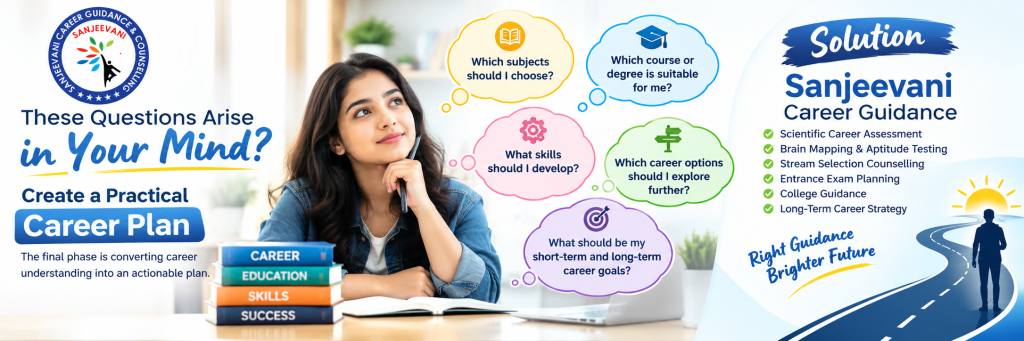
The final phase is converting career understanding into an actionable plan.
A good career counselling process should help answer questions such as:
Which subjects should I choose?
Which course or degree is suitable for me?
What skills should I develop?
Which career options should I explore further?
What should be my short-term and long-term career goals?
This makes career guidance more practical than simply receiving a list of professions.
Why Choose Sanjeevani for Interest-Based Career Guidance?
Sanjeevani focuses on helping students and individuals understand themselves before making important career decisions.
The combination of Advanced Psychometric Test, Advanced DMIT Test, professional interpretation, and manually prepared career reports is designed to provide a more personalised career-guidance experience.
For someone searching for career counselling based on interests and personality, the key advantage is the opportunity to look beyond marks and popular career trends.
A career should not be selected simply because someone else is successful in it. Your interests, personality, strengths, abilities, learning style, and goals all deserve consideration.
Final Thought
Choosing the right career becomes easier when you first understand yourself.
An Advanced Psychometric Test can provide structured insights into interests, personality, and preferences, while an Advanced DMIT Test can be used as an additional tool to discuss individual strengths and learning preferences. At Sanjeevani, the emphasis on manually prepared and personalised reports adds a human interpretation to the assessment process.
If you are confused about which career is right for you, professional career counselling and career assessment can help you move from confusion to a more informed career direction.