
 admin
adminChoosing the right career is one of the most important decisions in a student’s life. In 2026, students in India have access to more career opportunities than ever before. Traditional professions such as medicine, engineering, law, teaching and government services continue to attract students, while emerging fields such as Artificial Intelligence, Data Science, Cybersecurity, Digital Marketing, EV technology and sustainability are creating new opportunities.
With so many choices available, students can easily become confused about which course, stream or profession is right for them. The highest-paying career may not always be the most suitable career. Academic performance, interests, personality, skills, financial circumstances, educational qualifications and future industry demand should all be considered. Sanjeevani Career Guidance helps students understand these factors and make informed career decisions based on their individual strengths and goals.
What Are the Best Career Options in India in 2026?

The best career option depends on an individual’s educational background, interests, abilities and long-term goals. Technology-based careers such as Artificial Intelligence, Machine Learning, Data Science, Software Development and Cybersecurity are experiencing strong demand. At the same time, healthcare, finance, law, management, government services, education and creative professions continue to offer substantial career opportunities.
Students who are interested in technology can consider AI, software engineering, data analytics or cybersecurity, while students interested in medicine can explore MBBS, pharmacy, biotechnology and allied healthcare. Commerce students can build careers in CA, finance, banking, investment management and business administration. Humanities students can explore law, psychology, civil services, journalism, teaching and design. Therefore, the best career options in India in 2026 should be evaluated according to personal suitability rather than popularity alone.
Highest-Paying Career Options in India in 2026
Several professions in India offer excellent earning potential after the required education, training and professional experience. Artificial Intelligence and Machine Learning are among the rapidly expanding areas because organisations across industries are adopting AI-based technologies. Data Science is another promising field where professionals use data, statistics and technology to support business decisions.
Investment banking, corporate law, medicine, Chartered Accountancy and actuarial science can also provide strong earning potential after professional qualifications and experience. Product management has become another attractive career for individuals who understand technology, business strategy and customer requirements. The source material identifies AI/ML, investment banking, medicine, law, data science, CA, actuarial science, product management, civil services and aerospace engineering among important high-paying career areas.
However, salary should not be the only factor when choosing a profession. The earning potential of almost every career depends on qualifications, experience, skills, location, organisation and individual performance. Students should therefore consider salary together with career satisfaction, growth opportunities and personal suitability.
Best Career Options After 10th in India
Class 10 is an important stage for career planning because students begin making decisions that influence their future academic pathways. After Class 10, students generally continue with Class 11 and 12 or choose a vocational and technical education route. For students who are academically prepared to continue school education, completing Class 12 usually keeps a wider range of professional and higher-education opportunities open.
Students who prefer practical and technical education can consider ITI or polytechnic programmes. ITI courses can provide training in technical trades, while polytechnic diplomas can help students develop practical engineering and technical skills. Students can also explore computer applications, agriculture and other vocational programmes depending on their interests. The source material highlights Class 11–12, ITI, polytechnic diplomas, computer applications, banking and accounts and agricultural training as possible routes after Class 10.
Best Career Options After 12th in India
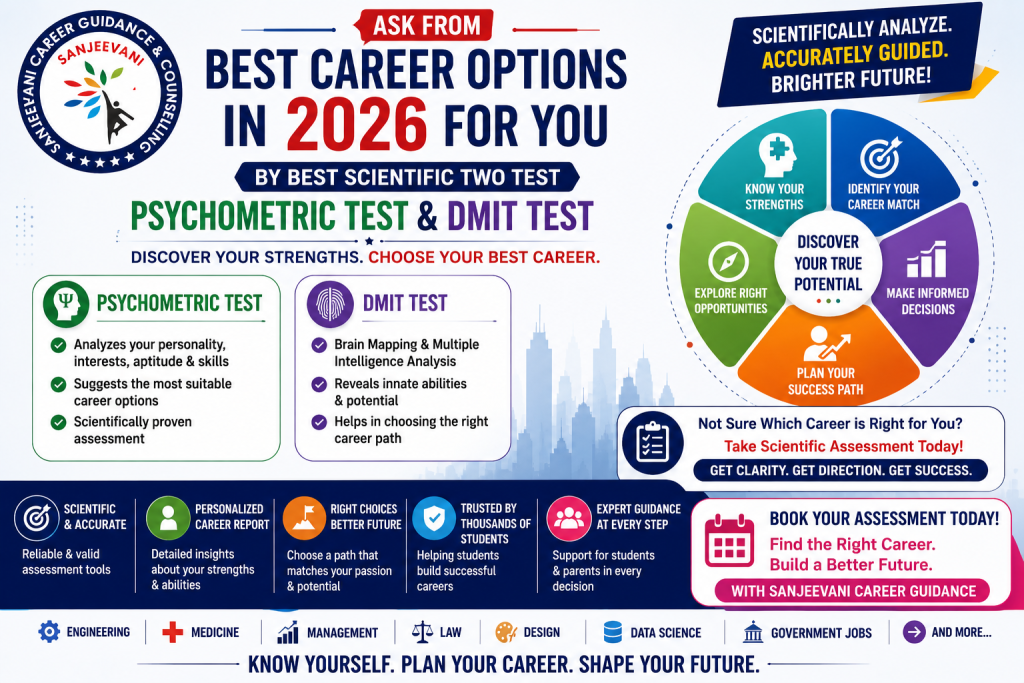
After Class 12, students have significantly more specialised career options. The stream selected during school can influence eligibility for different courses and competitive examinations. Science students can pursue engineering, medicine, architecture, biotechnology, pharmacy, IT and research. Commerce students can consider CA, finance, banking, management, business and accounting. Humanities students can explore law, psychology, journalism, civil services, education and social sciences.
Students should not select a course simply because their friends are choosing it or because it is considered prestigious. They should understand the eligibility requirements, duration, entrance examinations, career opportunities and future scope of the course before making a decision. Career counselling after 12th can be particularly useful for students who are unsure about which degree or professional course matches their abilities and aspirations.
Best Career Options After Graduation in India
Graduation provides a foundation, but students can significantly expand their career opportunities by developing specialised skills and professional qualifications. For example, a B.Com graduate can pursue CA, finance, banking, taxation, an MBA or specialised financial certifications. A computer science graduate can move towards software development, AI, machine learning, data science, cybersecurity or product management.
Students who have completed graduation but remain confused about their next step can consider postgraduate education, professional certification, competitive examinations or skill-based courses. Practical projects, internships and industry-relevant skills can also improve employability. The source material specifically highlights the importance of combining a degree with practical skills, projects and additional qualifications.
Emerging Career Options in India for 2026 and Beyond
The Indian employment market is changing because of technological development, environmental concerns, digital transformation and changing consumer needs. As a result, several emerging professions are becoming increasingly relevant. Artificial Intelligence, EV technology, sustainability, data privacy, climate analysis, space technology, healthcare AI and mental-health-related professions are among the areas identified as emerging career fields.
Students who are planning their careers for the next five to ten years should consider not only existing job opportunities but also how industries may change. Developing adaptable skills can be particularly valuable because emerging technologies can create new roles while changing traditional job responsibilities.
AI and Machine Learning Career Options in India
Artificial Intelligence is one of the most discussed career fields in 2026. AI is being integrated into technology, healthcare, banking, education, marketing, manufacturing and many other industries. Students with strong technical interests can explore careers such as AI Engineer, Machine Learning Engineer, Data Scientist and AI Researcher.
Students who do not have an engineering background can also explore certain AI-related roles after developing relevant skills. Prompt engineering, AI-assisted content, AI project coordination and AI product-related roles can provide alternative entry points depending on the individual’s background. Technical AI careers generally require programming, mathematics, statistics and machine-learning knowledge, while non-technical roles may focus more on AI tools, business understanding and practical applications.
Best Government Career Options in India
Government careers continue to be popular among Indian students because they are associated with structured recruitment, defined career progression and employment stability. UPSC Civil Services, SSC examinations, banking examinations, defence services, RBI, SEBI and railway-related careers are among the major options students consider.
Eligibility differs according to the examination. For example, many graduate-level examinations require a recognised bachelor’s degree, while some defence and other positions have specific educational and age requirements. Students should always check the latest official recruitment notification before preparing for an examination because eligibility, vacancies and examination patterns can change.
Best Career Options in Technology
Technology offers a wide range of career opportunities for students who enjoy computers, programming, mathematics and problem-solving. Software development, cloud computing, cybersecurity, artificial intelligence, machine learning, data analytics and product management are among the major areas students can explore.
A technology career does not always depend only on having a particular degree. Industry-relevant skills, projects, certifications, internships and practical experience can also play an important role. However, students should carefully understand the technical requirements of their chosen field and select courses that provide genuine learning rather than choosing a programme only because it is currently trending.
Best Career Options in Healthcare
Healthcare remains an important career sector because India’s growing population and healthcare requirements create continuous demand for qualified professionals. Students interested in biology and patient care can explore medicine, dentistry, pharmacy, nursing, physiotherapy, biotechnology and other allied healthcare fields.
Medical careers generally require significant educational commitment and professional training. Students should therefore understand the entrance requirements, course duration, academic workload and professional responsibilities before choosing healthcare as a career.
Best Career Options in Commerce and Finance
Commerce provides several career pathways beyond traditional accounting. Students can explore Chartered Accountancy, finance, banking, investment banking, financial analysis, taxation, business management, company secretaryship and entrepreneurship.
Students who are comfortable with numbers, business concepts and financial decision-making may find this field suitable. Additional qualifications such as CA, professional finance certifications or an MBA can further develop career opportunities depending on the student’s long-term goal.
Best Career Options in Law
Law is another versatile career field in India. Students can work in corporate law, litigation, intellectual property, taxation, compliance, legal consulting and other specialised areas. A law degree can also support careers in government services, legal research and corporate organisations.
Students interested in law should develop strong communication, analytical reasoning, research and writing skills. Choosing a recognised law programme and understanding the relevant entrance examination and professional requirements is important before beginning this career path.
Best Career Options in Digital Marketing and Creative Fields
Digital transformation has created opportunities in digital marketing, social media management, SEO, content marketing, graphic design, UI/UX design and online branding. These fields can be attractive for students who combine creativity with communication and technology.
Unlike some highly regulated professions, several digital careers can be entered through specialised courses, certifications, internships and practical portfolios. However, students should focus on developing real skills and demonstrating their work rather than relying only on certificates.
How to Choose the Right Career Option in India
Choosing from more than 100 career options can feel overwhelming, but the decision becomes easier when students follow a structured approach. The first step is to understand personal strengths and identify subjects or activities in which the student performs well. The next step is to identify genuine interests and determine whether the student is willing to invest several years learning and developing in that field.
Students should then research eligibility requirements, course duration, entrance examinations, fees, employment opportunities and future industry demand. It is also important to consider whether the desired career matches the student’s financial circumstances and preferred lifestyle. The source material recommends evaluating strengths, interests, market demand, qualifications, preparation timelines and realistic salary information before choosing a career.
Why Career Counselling Is Important for Students
Many students make career decisions under pressure from parents, relatives, friends or social media. Some select a course because it is popular, while others choose a profession because they believe it offers a high salary. Such decisions can create confusion and dissatisfaction later.
Career counselling provides students with an opportunity to understand their interests, abilities and available career pathways in a structured manner. A professional career counsellor can help students compare different options, understand educational requirements and develop a realistic career plan. The purpose of career counselling is not to force a student into one profession but to help them make a better-informed decision.
How Sanjeevani Career Guidance Helps You Choose the Right Career
Sanjeevani Career Guidance focuses on helping students and professionals gain clarity about their educational and professional direction. When a student is confused between multiple courses or career fields, structured guidance can help them understand which options are more closely aligned with their interests, strengths and future objectives.
Whether a student is choosing subjects after Class 10, deciding on a professional course after Class 12, selecting a college, considering postgraduate education or planning a career change after graduation, career guidance can provide a clearer framework for decision-making.
Sanjeevani Career Guidance can help individuals understand different career pathways, compare courses, evaluate future scope and create a practical roadmap instead of making decisions based only on trends or external pressure.
Salary Should Not Be the Only Career Factor
Salary is an important consideration, but it should not be the sole reason for selecting a profession. Every career has different educational requirements, working conditions, growth patterns and levels of competition. A profession that offers a high salary may also require many years of education and intensive preparation.
A better approach is to find the intersection between your interests, abilities, career goals, earning expectations and market demand. When these factors are considered together, students have a better chance of selecting a career that is sustainable and personally meaningful.
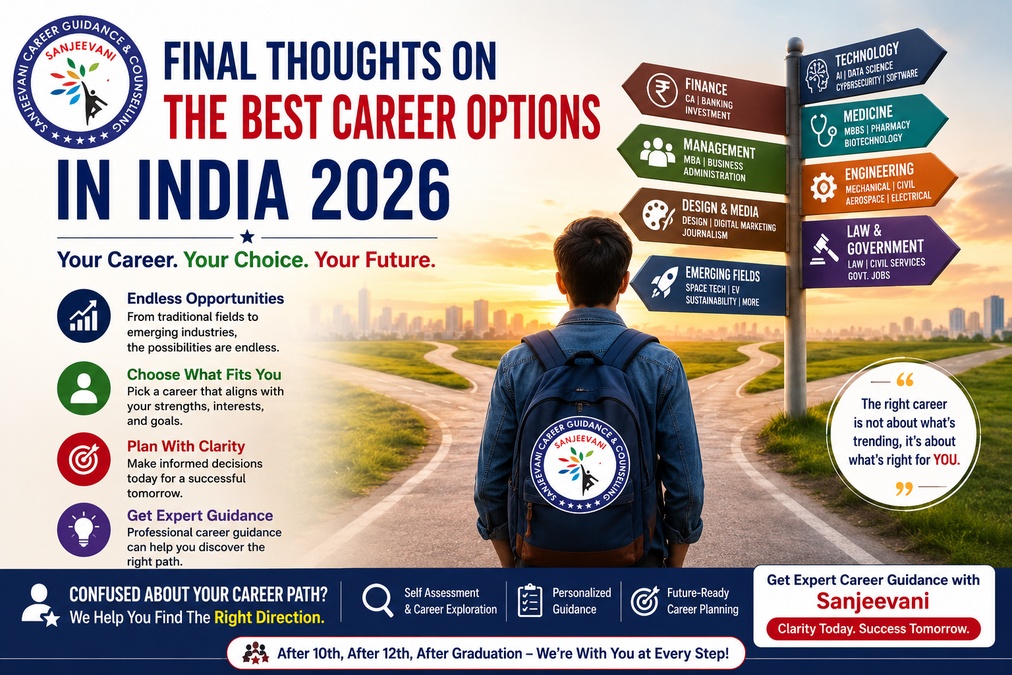
Final Thoughts on the Best Career Options in India 2026
India’s career landscape in 2026 offers opportunities across traditional professions as well as emerging industries. From medicine, engineering, CA, law and government services to AI, data science, cybersecurity, digital marketing, sustainability and space technology, students have more choices than ever before.
However, more choices can also mean more confusion. The right career is not necessarily the one that is currently trending or offers the highest advertised salary. It is the career that matches your strengths, interests, qualifications, personality, goals and realistic expectations.
If you are confused about which career to choose after 10th, which course to select after 12th, what to do after graduation, or which emerging career has better future scope, professional career guidance can help you evaluate your choices.
With Sanjeevani Career Guidance, students and professionals can approach career decisions with greater clarity, proper planning and a better understanding of their available opportunities.